
The Saga of the Construction of Brazil’s First Skyscraper
The construction of the Martinelli Building in the 1920s—Brazil’s first skyscraper—was made possible only by the entrepreneurial and adventurous spirit of Giuseppe Martinelli, an Italian immigrant who fled Tuscany at a young age due to the economic chaos that followed the unification of Italy.
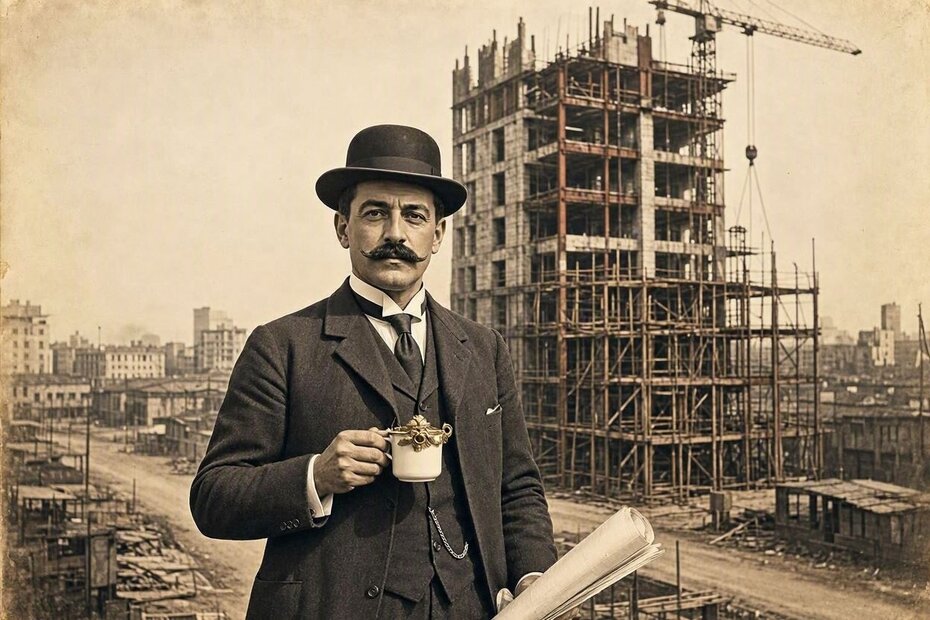
Image created by Bing Image Creator
Giuseppe was intently studying the blueprints for the building he had commissioned from a well-known Hungarian architect when his wife walked into the office carrying a steaming cup of coffee.
“Who would have thought that, thirty years after crossing the seas to this land of opportunity, a poor bricklayer from Tuscany would become the owner of Brazil’s first skyscraper!” he proclaimed aloud, drumming his fingers on his Bahia rosewood desk. “Well, it’s true that for now the project remains on hold, but I will finish my skyscraper!”
Under his wife’s proud gaze, he sipped his coffee carefully. “All that’s left is for me to melt my mustache again, woman! Why didn’t you bring the coffee in a cup with a mustache holder?” he said, disguising his recent outburst with a gruffer tone of voice. Giuseppe Martinelli was well aware that his bouts of vanity were not at all well-regarded by São Paulo society...
- “It’s time to leave, dear. I have a meeting with a panel of experts. Maybe today I’ll be able to get city hall to lift the construction freeze!’ He then stood up, carefully inspecting his reflection in the mirror. Dressed according to the standards of European masculine elegance, he wore a three-piece suit, a high, stiff collar wrapped in a silk bow tie, along with cufflinks and a gold watch tucked into his pocket. Before picking up his cane, he meticulously wiped away a smidgeon of Hungarian ointment that had accumulated at the corners of his mouth from contact with the hot drink.
A few months earlier, the construction of the Martinelli Building had been halted by city hall, as the building was being built without a permit or municipal license. The use of reinforced concrete was a novelty at that time, and no one understood how the combination of cement and iron could support loads so much greater than those of traditional construction. It seemed impossible that such a slender, tall tower could remain standing. People believed the building was about to collapse, and the builders themselves fueled this rumor. Many avoided walking on the same sidewalk as the construction site, imagining an imminent catastrophe.
Vilmos Fillinger himself, who had designed the building, decided to abandon the project when Martinelli decided that, instead of the 12 stories originally planned, the building would reach a height of 100 meters. Martinelli and his nephew then took over the project and decided that, with each new story built, a load test would be conducted to verify whether construction could continue. This test was performed by stacking a series of iron bars on the new floor slab. In this way, construction progressed up to the 24th floor before being halted.
However, after performing a series of structural calculations, the experts decided that the building could have 25 stories, and the construction freeze was lifted. To prove to everyone that the building was safe, Martinelli decided to add a five-story mansion to the top, with 15 luxurious rooms, and to move there with his family.
“But Uncle, didn’t the city limit the building’s height to 25 stories? Aren’t you afraid the building might collapse?” said his nephew, who worked as the engineer in charge of the project.
“I wouldn’t be the wealthy man I am today if I let fear rule me. When European merchant ships stopped coming to Brazil, fearing they would be bombed by the German submarines that roamed the seas hunting enemy ships, I founded my own shipping company, Lloyde Nacional. I made a lot of money by trusting my good fortune and transporting goods back and forth.”
Construction had reached the 26th floor when a short circuit in the electrical wiring sparked a massive fire, fueled by the proximity of the flames to flammable materials. For more than twelve hours, the public anxiously watched as firefighters battled the blaze despite a lack of adequate equipment. Assisted by civil and military police officers, as well as construction workers, the firefighters formed a human chain, passing buckets of water from hand to hand up the ladder until they reached the roof of the building.
In the days following the fire, the countless news reports published on the subject would remind the public of the various fatal accidents involving workers during construction and of the widespread fear that the building would collapse, unable to support its own weight. Thus began the superstition that the building was cursed and that it would cast such a massive shadow over downtown São Paulo that neighboring buildings would be permanently plunged into darkness.
Despite all the setbacks, Martinelli built the skyscraper with the utmost refinement: Carrara marble, Scandinavian cement, Belgian glass, crystal mirrors, elaborate hand-forged iron ornaments on the balconies and doors, and the use of skilled labor, with the arrival of 90 artisans from Spain and Italy, which cost him a vast fortune.
The building was finally inaugurated in the year of the New York Stock Market Crash (1929), which led to a freeze in the São Paulo real estate market, leaving the businessman without the financial returns needed to cover the loans he had taken out in Italy. This forced Martinelli to file for bankruptcy and hand over control of the skyscraper to the Italian government.
Giuseppe Martinelli died in 1946, shortly before the building was confiscated by the Brazilian government during the war.
This chronicle was inspired by the story of the construction of the Martinelli Building, Brazil’s first skyscraper. The dialogues presented here are not based on actual accounts but were created with creative license.
Voltar