
The Salamanca of Jarau
Did you think “A Salamanca do Jarau” was just a gaucho legend? In this version, I’ve blended historical facts, geological insights, and a touch of magic to tell the story of how the mysteries of the ancient Cova de Salamanca might have crossed the ocean and reached the gaucho pampas. Enjoy!
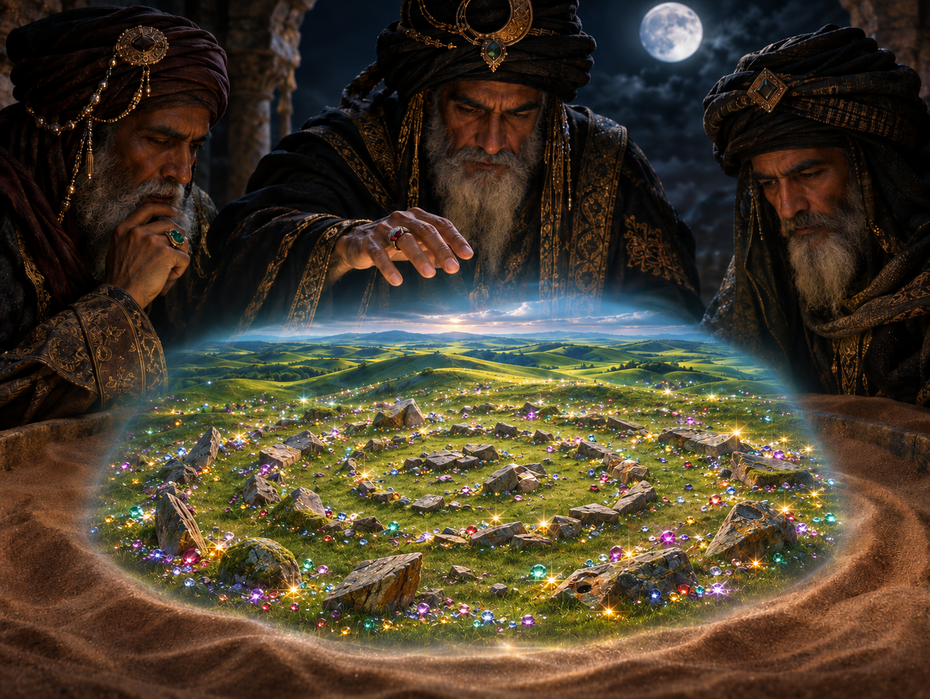
Moorish wizards look at the Jarau Hill during a geomancy session (by chatGPT)
This story begins in Spain in the year 1500, just eight years after the conquest of Granada by the Catholic Monarchs. The Moors had arrived on the Iberian Peninsula nearly eight centuries earlier and built a civilization there that stood out for its knowledge of astronomy, medicine, mathematics, and other sciences. But times had changed. With the victory of the Christians, the Muslims were coming under increasing pressure to abandon their beliefs and customs.
Among those most threatened were the students of a small clandestine school, set up beneath a church located near the city walls of Salamanca.
That night, Ibrahim al-Qurtubí slipped quietly into the church of San Cebrián. He walked among the nearly empty pews, paused before a side altar, and, after making sure no one was watching, made his way to a narrow vaulted staircase. He slowly descended the 25 steps, resting his hand on the bare stone walls. As he advanced, the air grew colder, and the scent of sulfur—which he knew well—began to replace the fragrance of incense.
“As-salāmu ʿalaykum, my brother. May Allah illuminate your paths!” greeted Yusuf al-Gharnatí when he saw him enter the Cave of Salamanca. “What news do you bring from the kingdom?
“Wa ʿalaykumu s-salām. May He protect the secrets we share,” replied Ibrahim, before turning to Mansur al-Mursí, who was also waiting for him.
The three were students at the mysterious school of magic that operated in that underground structure, consisting of cavities and hidden passages beneath the church of San Cebrián. According to whispered rumors in the city, the sacristan himself, who taught the classes, was an incarnation of the devil. The students preferred not to discuss the matter. After all, no one had ever seen him enter or leave the church, even though he was always present when they arrived for their lessons.
There they learned astrology, alchemy, divination, talisman-making, and other occult practices—knowledge that, passed down from generation to generation, had crossed the Mediterranean with the first Moors who arrived on the Iberian Peninsula.
Although they condemned witchcraft, the people frequently turned to its practitioners to cure illnesses, predict marriages, choose auspicious dates for travel, or acquire talismans against the evil eye. And it wasn’t just the poor who sought their services. From time to time, a luxurious litter would stop discreetly beside the church, and from it would step a noblewoman, hidden beneath a heavy veil.
That night, however, no one was interested in consultations or teachings.
“So, Ibrahim, what news do you bring us?” asked Mansur, unable to hide his anguish.
“Queen Isabel has ordered that the entrance to the Cave be sealed with stones and mortar. As for us, we will have to accept Christian baptism—or else face the consequences.”
A look of confusion spread across his companions’ faces, and Ibrahim promptly clarified the matter by running his index finger along his throat like the blade of a sword
“Sssic!”
“Barbarians!” exclaimed Mansur. “Without the knowledge our ancestors brought, this region would never have achieved such splendor!”
“Enough talk,” Yusuf interrupted. “We need to decide what to do before they come to arrest us.”
For a few moments, the three remained silent. Then Ibrahim suggested:
“How about we consult the sand?” The ilm al-raml has never left us without an answer.
Yusuf walked over to the shelves, rummaged through vials, small bones, crystals, and yellowed parchments until he found a copper tray. He placed it on the table and covered its bottom with a layer of very fine sand.
The three sat around the table, joined hands, and closed their eyes. They then began to murmur almost inaudible invocations. Shortly afterward, Yusuf, armed with a small metal rod, began to trace successive rows of dots in the sand.
For a while, nothing happened.
Then the flame of the oil lamps flickered, even though there was no wind in that cave.
Yusuf noticed that the dots were beginning to move. First slowly, then with increasing speed, the tiny indentations moved across the surface of the sand, forming concentric circles—like ripples that form on a calm lake when you throw a stone into it.
“I didn’t draw that,” Yusuf murmured.
Ibrahim raised his hand to signal silence.
A landscape of rare beauty began to emerge from the sand. As the minutes passed, its colors grew more vivid and its contours sharper. The three magicians felt as though they were gazing at it through a window open to another world.
They saw a vast field of grass-covered mounds, with no castles, roads, or buildings. Suddenly, a glowing star streaked across the sky, falling amid the mounds. The image then shimmered, and a concentric arrangement of rocks formed around the area where the star had fallen.
Scattered across the grass, they could now see crystals of amethyst, citrine, agate, and onyx, which reflected the moon’s glow, lending the scene a mysterious aura.
But there was something else.
The circles seemed to breathe.
With each pulse, the rocks glowed for a brief moment, as if an unknown force were trapped beneath the earth.
“A shooting star…” whispered Ibrahim, fascinated. “How long has it been buried there?”
Mansur leaned over the table to get a better look and, without meaning to, let go of his companions’ hands. At that moment, the landscape began to fade away. The crystals lost their luster, the hills dissolved into a mist, and the circles vanished, leaving only the initial marks of the divination on the sand.
For a few seconds, no one moved. Only a cool breeze, carrying an unfamiliar scent of grass and damp earth, swept through the chamber and slowly rose up the staircase.
“But where is this place?” Yusuf and Mansur asked in unison.
Ibrahim did not seem troubled. He had already spread his astrological instruments across the table and was now carefully examining the celestial chart he had drawn.
“The stars confirm that we must leave. And quickly. We have only three days before the favorable conjunction for our journey comes to an end.”
“Leave for where?” asked Mansur.
“To the west. Beyond the Dark Sea. We’ll join the Portuguese navigators who are about to set sail for the Indies. The charts indicate that our destination lies far beyond the known lands.”
“And will we take the princess with us?” Yusuf asked.
“Of course.”
Mansur smiled thoughtfully:
“If we use those crystals to concentrate the energy emanating from this place, we’ll be able to multiply our powers. If we combine that with our knowledge of alchemy, we’ll be able to turn all that wealth into gold. Praise be to Allah!”
Yusuf did not share his enthusiasm. With his head bowed, he felt overcome by a deep sadness. He loved that land where his ancestors had lived for so many centuries. There lay his memories, his dead, his language, and everything that gave meaning to his existence. Leaving would be like tearing out his own roots.
And then there was the Moorish princess…
How would they manage to cross the ocean while carrying a woman whose beauty, it was said, had already caused men to lose their minds?
Three days later, on March 9, 1500, the three magicians and the princess stowed away on Pedro Álvares Cabral’s fleet, which set sail from Portugal bound for the Indies.
The princess was disguised as a maid, wrapped in a dark, worn cloak that covered her from head to toe. She walked hunched over, leaning on a cane. No one suspected her identity, for the magicians had cast a spell on her cloak: even when the sailors claimed to have seen her face, they were unable to recall it.
The voyage was grueling.
The days dragged on amid the suffocating heat, spoiled food, and the ship’s endless rocking. When they finally sighted the Brazilian coast a month and a half later, the travelers were so weakened that they decided to abandon the fleet at the first opportunity. They fled clandestinely to dry land, taking only their magical instruments, some provisions, and the few precious objects they had managed to hide.
Ibrahim consulted the stars once more.
“We’re still far away. We need to head south.”
It is not known how long they traveled, nor which paths they took. Perhaps they sailed along the coast; perhaps they crossed unknown forests and rivers with the help of the inhabitants of those lands. The accounts of this part of the story are contradictory, and some even mention events so extraordinary that they are not to be trusted even among storytellers.
What is certain is that, much later, the four travelers reached the fields of the far south.
There, the forests gave way to a vast expanse of low hills covered with grass that undulated in the wind, and the sunset seemed to consume the days in flames.
It was on a late spring afternoon that they finally spotted in the distance a range of hills where rocky outcrops rising from the ground formed the same irregular rings they had seen in the sand of the Cova de Salamanca.
Yusuf was the first to recognize the place.
“Ibrahim… Look!”
It was the place we know today as Cerro do Jarau, in southern Brazil.
Mansur ran a few steps, overcome with excitement, but stopped abruptly. The ground beneath his feet had just trembled. At that moment, Ibrahim knelt down and pressed the palm of his hand against the earth. A slow, deep pulsation continued to shake the area, leaving them all frightened.
The Moorish princess, who had remained silent ever since they had left Spain, took a step forward, removed her veil in a slow, graceful gesture, and spoke:
“We’ve taken too long.”
At that moment, deep beneath the stone circles, something awoke.
End of the First Chapter
This story continues in the short story “A Teiniaguá,” which will be published soon. Please stay tuned.
See below for the historical facts and geological elements that have been added to the original legend:
· The Moors brought with them a tradition of occult practices when they invaded the Iberian Peninsula in 711 A.D.
· There is a church called San Cebrián in Salamanca, near the old city wall. Beneath it lies a place called the Cueva de Salamanca, where records indicate there was once a school of the occult
· The Jesuit Martín del Río (1551–1608), a leading scholar of demonology, states in his work *Disquisitionum magicarum* (*Magical Disquisitions*), first published in 1599, that Queen Isabella the Catholic ordered the entrance to the Cueva de Salamanca to be sealed with stones and mortar
· In the Quaraí region of Rio Grande do Sul, there is a concentric arrangement of rocks on the hills identified as an astrobleme, a geological feature formed by a meteorite impact. Cerro do Jarau is located in this region.
· The practice of geomancy, which uses a tray covered with a layer of sand, does exist, but in this story it has been taken to the next level.
Thank you for reading this far. I’ll see you in the next story!
Voltar