
The Teiniaguá
In this final chapter of a legend from southern Brazil, titled *The Salamanca of Jarau and the Teiniagua*, you’ll discover what happens after the wizards and the Moorish princess arrive at Cerro do Jarau. Get ready to meet a hilarious new character!
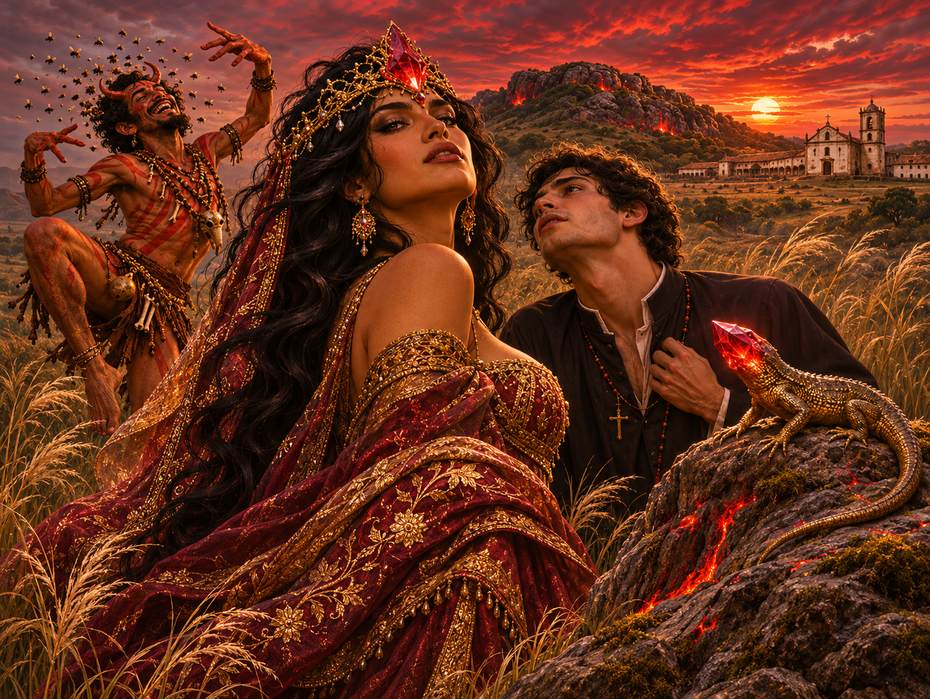
The moorish princess, the sacristan and the demon (by chatGPT)
The Atlantic crossing, from the Iberian Peninsula to the shores of that continent, had been arduous. But the overland journey was even worse. They had crossed forests inhabited by monstrous anacondas, tribes of cannibal Indians, and rivers so wide and turbulent that they resembled seas.
When they finally reached Cerro do Jarau, they could hardly believe the beauty of those lands! The vastness of the lush pampas, the fragrant breeze, the song of the quero-queros! And, as if all that weren’t enough, a blazing sunset, whose last rays seemed to caress the circular arrangement of rocks that had once appeared to them in a vision at the Cova de Salamanca.
Enraptured by the end of the journey, the Moorish princess slipped off her cloak and spread her arms wide to feel the breeze against her skin.
Johara—that was her name—possessed a mesmerizing beauty, capable of making a man lose his reason. Her black hair cascaded in lustrous waves down her back, framing large almond-shaped eyes from whose pupils green sparks seemed to spring. Her full lips, narrow waist, and generous hips completed a figure that moved with the languid grace of desert creatures.
A filigree gold tiara, studded with diamonds, rested upon her forehead. At its center, a massive red stone, cut like a ruby, seemed worth a fortune. But the magicians’ watchful eyes suspected that a mystery lay hidden behind that brilliance.
Ibrahim noticed that the sun was about to set and that the dew was already dampening his clothes.
“It’s time to find shelter and light a fire to scare off the nocturnal beasts.”
“Ibrahim, look!” exclaimed Yusuf, pointing toward the hillside. “A cave! Perhaps we can spend the night there.”
Shortly afterward, once they had settled inside the cave, they ate a light meal and prepared for bed, eager for the next day to arrive and for the discovery of the mysteries that awaited them.
It was then that, from the depths of the cave—which they had not dared to explore—a muffled buzzing began to emerge, which soon became deafening. And, to their astonishment, a little man appeared, hopping about and laughing like a madman amid a cloud of blowflies.
“Ha, ha, ha! Oooh! Not there, you little rascal! Stop!”
The travelers watched the scene with their mouths agape.
The little man’s body was smeared with annatto, and around his neck he wore a necklace of seeds, teeth, and shards of reddish jasper. Red-dyed fibers adorned his arms and ankles. Bones, claws, and small amulets hung from his waist, clinking together with every step of his dance. He whirled barefoot and, from time to time, paused his swaying to catch one of the flies that formed a sort of tiara above his head. Then he would swallow it, delighted, and resume his dance.
Upon noticing the strangers’ presence, he flashed a mischievous smile:
“Aguyjevete, Johara porã! And my karai guasu! What fair winds have brought such an illustrious entourage to my domain?”
“Who are you?” asked Ibrahim.
“The Indians call me Anhã. The priests say I am Satan.” I let them call me whatever they want, as long as they don’t bother me.
“And how did you know we were coming?”
Anhã burst out laughing.
“So you don’t know why you ended up here? Ah, these wise men! They know the secrets of the stars, but they’re oblivious to the mysteries they carry within themselves!”
He pointed to the princess’s tiara.
— Millions of years ago, a fiery stone streaked across the heavens and shattered before reaching Earth. One of its fragments fell here, leaving this scar on the earth’s surface.
Another came to rest in the sands of the desert from which you came. And from that wound was born the red glass that adorns your forehead, Johara.
The princess touched her tiara.
— But what does that have to do with me?
— Ah, my beauty! The stones that were once sisters continue to seek one another, even when separated by oceans and deserts. Your crystal has not forgotten the Jarau. And when your heart stirs, it awakens the dormant forces beneath these rocks.
Johara removed the tiara. The four of them leaned over the stone, which was now emitting a pulsating red light, as if it were alive.
“When Manahára, the Eye of Anhã, my favorite spy, announced your arrival, I was delighted! For centuries I have endured the company of these Indians. They do not covet riches or power, nor are they easily seduced by lust. They lack the vices of civilization!
He paused to examine Johara from head to toe.
“But you, sublime creature, will be very useful to my purpose of stirring up greed among men...”
Before she could react, Anhã took a deep breath and blew his fiery breath upon her.
In an instant, the princess was transformed into a lizard, still bearing the immense red crystal atop her head. Terrified, she took refuge in a crevice in the rock and vanished.
Satisfied with his own mischief, the demon vanished into the depths of the cave, leaving behind only a smell of sulfur and tiny, smoking footprints in the mud.
In the years that followed, the sorcerers remained in Jarau, strengthening their powers with the energies emanating from the site. They learned to transform semiprecious stones into treasures, and little by little, the cave’s fame spread throughout the pampas.
A century later, it was still said that the fortunes of the region’s former landowners had been born of the advice of those sorcerers. The cave came to be known as the Salamanca of Jarau.
But no one dared to venture into its depths. It was said that anyone seeking riches there would have to face terrifying trials, remaining unmoved by everything they saw and heard.
Two hundred kilometers away, on the other bank of the Uruguay River, the Jesuit Mission of San Tomé had been founded, with the aim of converting the Guaraní to Christianity and consolidating the Spanish presence in the region.
Among the young priests who had come from Córdoba to work in the missions was Baltasar de Villalobos.
— Hey, Baltasar! “How’s it going, man? Have you finished your chores at the church yet?”
“Hello, brother! Yes, everything’s done for today. I’m going to the river to take a bath—it’s hot as hell out here.”
“Go with God, then! But don’t be late; it’ll be dark soon.”
“Don’t worry, brother. I’ll be back before the bell rings.”
Baltasar was young and vigorous, and the prudish atmosphere of the mission bored him. So, at dusk, he would often walk to a backwater of the river where the Indian women bathed. Hidden among the vegetation, he watched them take off their cotton tunics and enter the water, where they played carefree, their breasts exposed.
One such day, his attention was drawn to a reddish flash. On a rock, a lizard was basking in the last rays of the sun. On its head was a precious stone, which reflected the sun’s rays in a red flash.
Amazed, Baltasar picked up the cotton shirt he’d left drying on the grass and, with a swift motion, threw it over the creature.
It was enough to break the curse that had weighed on Johara for over a century. In place of the lizard, a woman appeared—in the flesh. And what a figure she had!
Naked as the day she was born, the princess looked at Baltasar, who took a while to recover from his astonishment. When he finally came to his senses, he handed her the cassock so she could cover herself.
“What is your name, my beauty?”
“Johara.”
“And what does your name mean?”
“Precious stone, my young man. But there are stones that hide a curse…”
By the time they reached the mission, it was already pitch dark. Not knowing where to shelter the stranger, Baltasar decided to hide her in the sacristy until the priests fell asleep.
He opened the drawers of the large cedar cabinet, adorned with carvings made by the indigenous people, until he found a carefully folded alb. Johara took off her sweaty cassock and put on the long white tunic, fastening it at the waist with a cincture. Not even that garment could conceal her beauty! Baltasar was unsettled by the thought that the alb—a symbol of purity—now touched the bare skin of an enchanted Moorish princess.
To drive away his sinful thoughts, he went to fetch a bottle of wine reserved for Mass. But when he found it, he hesitated.
Was he stealing the blood of Christ to please that woman? No—after all, the wine hadn’t been consecrated yet…
Reassured, he returned to the sacristy with the bottle.
The wine was delicious and went down his throat like honey. After three bottles and listening to Johara’s extraordinary adventures, Baltasar already felt like her closest confidant.
What a handsome and attentive man, thought the princess, who in the past century had had only lizards for company.
Baltasar, for his part, was hopelessly in love. Like so many others before him, he had just lost his mind.
Poor sacristan that I am! My future in the Church is about to go down the drain. But how can I resist this creature?
“Mi tesoro, mi amor… Come lie down beside me…” murmured Johara.
Amid whispers and caresses, they ended up giving themselves over to love on the floor of the sacristy.
That was when the red crystal, now resting among the garments scattered across the floor, began to emit an intense light.
The first tremor was so brief that Baltasar thought he was feeling dizzy. But soon the floor shook again, this time with enough force to knock over a candlestick. The altar shifted, cracks appeared in the walls, and the bells began to ring on their own.
“¡Dios mío!” exclaimed Baltasar, clinging to the altar table.
Johara didn’t seem frightened. On the contrary, her eyes had taken on that strange greenish glow.
“What’s happening, woman? Could this be divine punishment?”
“No, Baltasar. It’s a call.”
The commotion caused the monks to rush out of their quarters. Earthquakes were uncommon in that region. Then, the sacristy door burst open.
It was the superior, who had come to save the ornate silver liturgical objects. Upon seeing Baltasar and the Moorish princess, his face turned purple with hatred. Without giving them time for explanations, he expelled them from the sacristy, completely naked.
The entire community, which had gathered in the courtyard to escape the earthquake, now watched the spectacle. The indigenous people took advantage of the occasion to get a better look at the features of those bodies, which they rarely saw uncovered. The priests, for their part, were already imagining the mortifications they would have to impose on their own flesh to atone for the torment caused by the sight of that woman, who could only be the incarnation of the devil.
Baltasar and Johara barely had time to put on the cotton tunics offered by the Indians and gather their few belongings before being driven out of the mission amid the shouts of the superior priest.
Baltasar left São Tomé with his head bowed, carrying a bundle containing what remained of his former life. Ahead of him walked Johara, barefoot, her hair blowing freely in the wind and the red crystal glistening on her forehead.
She walked with the lightness of someone who had just received a blessing. From time to time, she turned to her beloved and smiled at him, enchanted by the prospect of taking him to live with her in Salamanca do Jarau.
“Where are you taking me, Johara?” Baltasar asked, distressed.
“To my home, my love. No one will bother us there.”
“And where is your home?”
Johara pointed toward the horizon, where the last stars were fading in the light of dawn.
“There, where the red lights spring from the ground.”
Baltasar sighed. He didn’t know if he had just found happiness or if he was approaching the gates of hell. Only time would bring the answer...
Far from there, deep within Cerro do Jarau, a little man awoke beneath his crown of blowflies. He stretched, caught one of the flies, and swallowed it with satisfaction.
“Ah, at last!” he exclaimed, leaping up. “Now we’ll have some fun!”
Ever since then, on nights when the people of the Quaraí region feel the earth tremble, they all turn their eyes toward Cerro do Jarau, searching for the red lights escaping through the cracks in its rocks.
Voltar