
How the White Man Came to Be (Tales of Taquiti 5)
This is the fifth chapter of a story written by a white woman about an Indigenous legend concerning the appearance of the first white man. Please excuse the irony in the text; it does not appear in the original legend.
If you haven’t yet read the preceding chapters, please click here (link to Chapter 1).
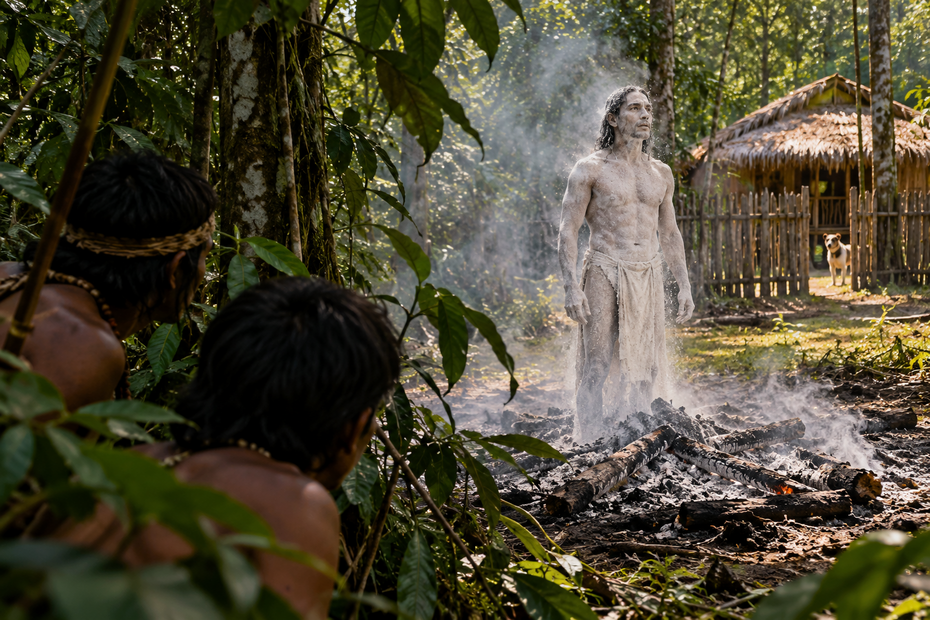
Awkê rises from the ashes (by chatGPT)
- Today I’m going to tell you how the first white man came to be. Did you know he was born from the ashes of an Indigenous person?
- A white man like my dad? – asked Mateus, while Nhá Taquiti pulled the linen sheet and smoothed the fold over the boy’s chest.
- Yes, your father. Your father - replied Nhá Taquiti, her eyes fixed on the open window, through which a cool breeze and the song of night birds drifted in. She then took a deep breath and began her story:
“When Rorê burst into the village, he was making such a commotion that all the women who were resting in their hammocks at that moment abandoned their nap and gathered around him in the central courtyard. The little monkey let out high-pitched screeches, leaped from one lap to another, and dashed off in short sprints toward the woods from which he had emerged, as if he wanted to show them something. It didn’t take long for the women to understand his call and begin to follow him.
Rorê leaped through the treetops, while the women ran after him along the trails that wound through the woods. The sun was already sinking below the horizon when they heard a child’s cry coming from a clearing. Upon arriving, they came upon a newborn baby, clean and snug in a soft bed of dry leaves, right there on the forest floor. A beam of golden light pierced the foliage and gently illuminated the baby’s tiny body. Just then, a gentle breeze swept through the clearing, lifting a handful of leaves that swirled through the air before settling back on the ground. Enchanted by the beauty of the scene, the women approached in silence.
Rorê climbed down from the trees and, letting out soft, affectionate grunts, began carefully removing the leaves still clinging to the baby’s damp skin. Since there was no one else around and the child would soon need a mother’s care, the women decided to take her to the village before nightfall.
When they arrived at the village carrying a baby in their arms, the women caused such a commotion among the other villagers that no one noticed Játáti, who was coming a little behind them, covered in blood, with her hair tangled and her face streaked with tears. But Rorê, faithful to the love he felt for her, approached cautiously, took her hand, and led her to the house where the baby had been taken and was now being fed.
When the women saw the state Játáti was in, they immediately understood what had happened. But since she rejected the child and refused to speak about it, the newborn was entrusted to the care of another woman in the village who had recently given birth.
Awkê—that was the boy’s name—grew at an unbelievable rate and remained shrouded in the same mystery that had marked his entire time in his mother’s womb. Whenever he was taken to visit relatives living in a nearby village, his cousins would say that he turned into a jaguar as soon as he ventured into the woods. Others swore that he took the form of a fish when he dived into the waterfalls that plunged over the nearby sandstone cliffs.
It wasn’t long before even his own family began to fear him. His behavior was unpredictable, and no one knew what other powers he might yet manifest. Rumors circulated that, sooner or later, he would bring great misfortune upon them all.
It was then that his uncle decided to eliminate him. But no matter how hard he tried, Awkê always reappeared, safe and sound, as if nothing had happened to him.
Not understanding what was going on, the boy once asked his grandmother why they wanted to kill him. The old woman, sitting with a long wooden board between her legs—into which small fragments of stone had been embedded like teeth—continued to grate cassava, pretending not to have heard the question. After all, why should she give explanations to that boy whom no one else considered worthy of attention or affection?
Until, finally, Awkê was thrown into the flames of a huge bonfire. His body, reduced to ashes, was abandoned by the river, right where the villagers used to hear him speaking an unknown language as he wandered alone along the banks. That night, his mother wept unceasingly, imagining how different everything would have been if he had been a child like the others. His relatives, however, celebrated. They were finally free of that extraordinary being! Now they could go about their own lives without having to worry about the rumors circulating through the village. After all, what right did that boy have to be different from the rest?
Some time later, the mother asked that they go retrieve her son’s ashes, and two men set out for the site. But what they found left them stunned. Where the ashes had once been abandoned, a house now stood, surrounded by a courtyard, where an animal—resembling the wild dogs that roamed the forest at night—barked furiously at the visitors. When the door opened, a man emerged, his skin as white as the ashes that had been left there. The men were spellbound by the man’s pallor. They had never seen anything like it in their lives.
The white man held an ornate stick in his arms, pointing it in their direction. Yet he smiled peacefully, and as soon as the Indians approached, he began to speak to them in that same strange language that Awkê used to speak when he wandered alone through the woods.
The boy who had been rejected, murdered, and burned had been reborn, transformed into a white man!”
Voltar