
Memoirs of a Stallion and His Young Queen
This short story is based on the true story of Kristina Vasa, who ascended to the Swedish throne in 1632 at the age of six, as told from the perspective of her horse.
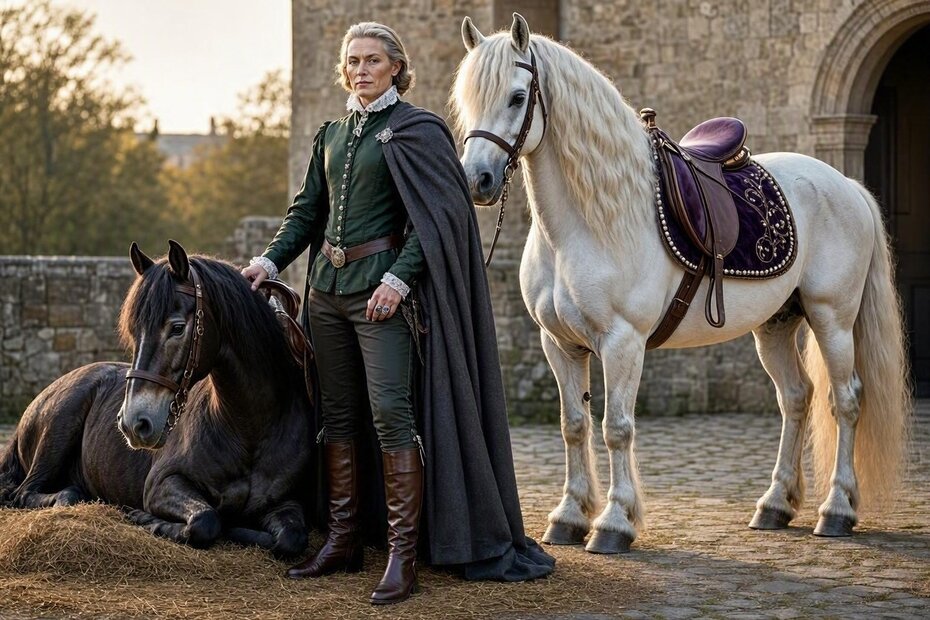
Image Generated by Bing Image Creator
I still remember the day she was born. I was grazing peacefully in my stall, surrounded by hay and oats—a luxury that few horses in the kingdom could enjoy at that time. In the kingdom’s capital and the surrounding regions, the villagers lived a daily life marked by poverty and widespread hunger. So, as I ate, I watched the midwives cast envious glances at my feedbag, from which not a single grain of oats escaped.
“If only God would let me provide such a rich ration for my horse, who’s getting thinner and more emaciated every day—poor creature!” raged the midwife’s assistant, as she wiped her hands—still stained with blood—on her apron and scanned the ground carefully, hoping to gather a handful of grains scattered there.
“Don’t complain, woman. At least we’re invited to fill our bellies every time we come to deliver a baby. And as today was a special day for everyone… Did you see the king’s joy when we announced the birth of his little prince? All hairy and with such strong lungs! They sounded more like the shouts of a tavern keeper…,” her companion exclaimed with a laugh.
Poor, stupid creatures! They were so concerned with guessing what their next meal would be that they barely realized they had given birth to a girl. Later, they would make up lies, trying to convince everyone that the baby cried with a hoarse, strong voice like a boy’s. But who has ever seen a newborn with a hoarse voice?
When the queen learned she had given birth to a girl, she fell into a deep depression and began to stubbornly ignore the baby. Abandoned to the care of her nannies, Kristina grew up like a stray dog. Even as a small child, I remember the many accidents that befell her: a ceiling beam mysteriously came loose and fell onto her crib, a gust of wind sent her tumbling down the stairs, and a clumsy nanny let her slip from her arms. This fall was so severe that for the rest of her life, Kristina would have one shoulder higher and more developed than the other, giving her a rather ungraceful, asymmetrical appearance.
King Gustav Adolf, the Great, was absent from the castle most of the time due to the wars. Meanwhile, Kristina’s mother’s mental state was deteriorating, and increasingly loud screams could be heard through the castle windows. Shortly after each of these outbursts by Queen Maria Eleonora, my little girl would appear in the stable, and as she combed my mane with her tiny fingers, I would see tears streaming down her face.
Despite all her misfortunes, I often saw her running by, dressed as a boy, sweat streaming down her forehead and her hair blowing in the wind. The king had ordered that she be raised as a prince, and so it was done.
At the age of six, my dear princess lost her father, who was killed on the battlefield. Her mother, who had already been in a rather poor state of mind, ended up sinking into a deep depression, on the brink of madness. Kristina, who until then had lived a carefree and unrestrained life, would now spend her days confined to a dark room, with black walls and curtains, filled with funerary symbols on all sides. Maria Eleonora had ordered that her father’s heart be torn from his chest and kept in a golden box, within her reach. The castle servants whispered through clenched teeth that, every night, this box was placed at the head of the bed where the queen and her daughter slept. On the rare occasions when I saw my princess pass by, her face was always as white as a sheet of paper, and her fingers remained lifeless, clutching the hem of her garment, oblivious to the silky touch of my mane.
The situation at the castle became so complicated that Sweden’s Regency Council decided that the queen would be sent to Gripsholm Castle, where she would be confined for political reasons, and Kristina Vasa would succeed her father to the Swedish throne. When these events unfolded in 1632, my dear was merely six years old! Her kingdom included, in addition to Sweden, Finland and Estonia, as well as parts of Norway, Germany, and Russia.
Seeing her mother devastated by love and dependence on her husband’s presence, and watching her transform the memory of her father into an almost mythical presence, turned my dearest into a wild, independent soul who was averse to marriage. At court, she had become famous for her outbursts of bad temper and her ruthless behavior toward her servants.
But everything seemed to change on the day Kristina turned 12 and her guardians finally agreed to let her fulfill her greatest dream: to ride a horse! That day, her fingers eagerly grasped my reins the very moment she balanced herself in the saddle, and, bumping and jolting along, we paraded through the courtyard in ecstasy, oblivious to the light rain that fell without ceasing. When she dismounted, she wrapped her little arms around my neck and, with a shy kiss, declared, “I baptize you, Natt.” People say she rode like a man, but I swear that’s a complete lie! Kristina sat sideways in her side-saddle, like all women did back then In fact, I can't remember another time in her life when she acted like a proper young lady...
Before long, my queen had become an exceptional horsewoman. We would spend long hours riding through the palace grounds, accompanied by her dogs and an overwhelming sense of freedom. I had never seen her as happy as when she was with me...
Occasionally, I’d see her walking with her ladies-in-waiting. She stood out from the rest, always dressed in her men’s clothes, with her deep voice and her low tolerance for the routine and social conventions that seemed to shape the behavior of all those young ladies. I never saw her show any sexual or romantic interest in the young men of the court. But then came the day she met Belle. For an entire week, I didn’t see her. I wondered what illness had befallen my queen, preventing her from riding.
When she finally reappeared, she was arm in arm with the woman I would later discover was named Ebba Sparre, her new lady-in-waiting. I noticed she had gorgeous rosy cheeks and a pair of sparkling eyes—that damn traitor. In the twelve years we’d known each other, she had never abandoned me for so long without a just cause!
From then on, I would spend hours on end listening to them discuss issues of gender, culture, and philosophical questions. “Belle,” she would say one day, “Stockholm will soon be known as the ‘Athens of the North.’ Even Descartes has promised me he’ll come spend some time at our court.”
No one made any secret of how shocking they found the emotional and sexual bonds that Kristina and her beloved Belle flaunted. To anyone who dared to criticize, Kristina would reply, “The soul has no gender.” One day, my queen had the audacity to introduce her Belle to the English ambassador as her “bedmate”! In addition to Belle, my dearest would cultivate intense bonds with several other young women, though none would ever be as important to her as Belle.
As the years went by, my health and appearance declined. So when the day of the coronation ceremony finally arrived—at the age of 24—my beloved was presented with a beautiful white stallion whose tail and mane were so long they touched the ground. Kristina was supposed to follow tradition and take part in the coronation procession, riding into the city of Stockholm on her horse. But my dearest never respected traditions…
Unwilling to let me down, her longtime companion, Kristina chose to take part in the procession in a beautiful carriage, specially brought from Paris for the occasion. Her new horse, whom she named Måne, trotted right behind her, taking prominent position among the more than 1,500 horses that were part of the event. Adorned with an extremely heavy cape featuring a four-meter tail, all embroidered with tiny crowns in gold thread and pearls, my queen looked stunning! Måne was dressed for the occasion, having been given a saddle lined with purple velvet -embroidered like my queen’s cloak—and silver horseshoes. How sad it was that I lacked the strength to take part in such an important moment in Kristina’s life! It was with secret joy that I watched my rival lose her silver horseshoes during the procession, but everyone considered this a sign of good luck.
Despite the good omens, just five years later Kristina Vasa abdicated the throne, handing over power to her cousin Karl Gustav and converting to Catholicism. One morning in 1655, my queen, at the age of 28, appeared in the stable to say goodbye to me before leaving in disguise, dressed as a man. She went on to Rome, where she lived until her death at the age of 62.
Shortly after her departure, I would die, and I was not alive to witness my eternal queen’s struggle for the thrones of Naples and Poland. Although she employed the most despicable means in these power struggles, she maintained an intense correspondence with three popes throughout her life and earned the rare honor of being buried in consecrated ground at the Vatican.
Translated by DeepL (free version)
Voltar