

The risk of being stupid
Bonhoeffer’s theory of stupidity applies very well to the times we are living in because it does not equate stupidity with a specific party or political movement. The mechanism he describes—submission to the group, the repetition of slogans, and resistance to facts—can occur across any ideological spectrum. This makes his social critique all the more interesting.
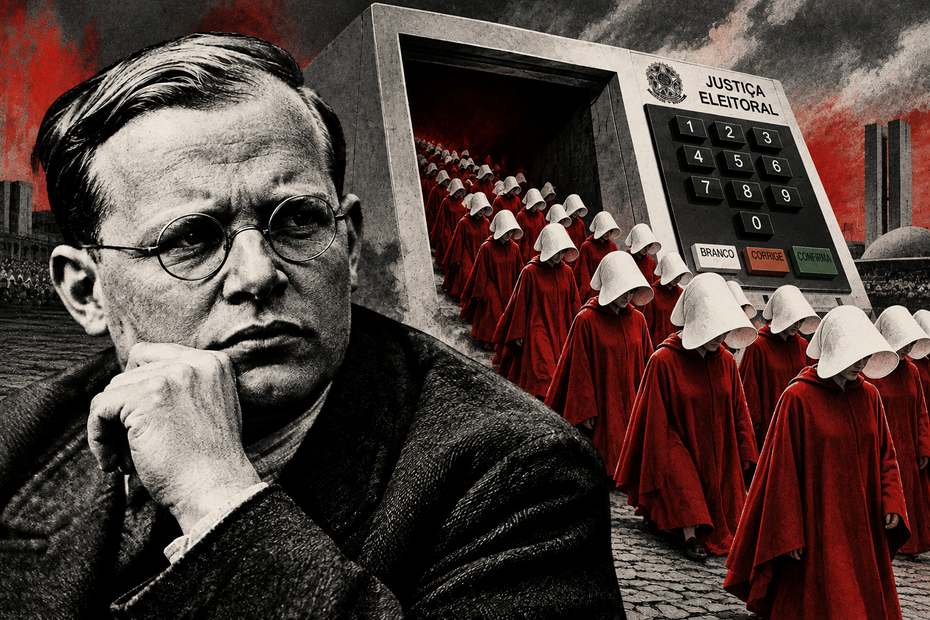
Bonhoeffer and the risk that individual stupidity could lead to an authoritarian regime that curtails individual freedoms (Image generated by ChatGPT)
It’s comforting to think that humanity’s greatest danger comes from evil men. After all, evil usually leaves clues. Such a person conspires, lies, steals, oppresses, persecutes, and, with any luck, ends up being exposed. We can denounce him, put him on trial, arrest him, or simply cross the street when we see him coming.
The problem begins when we discover that there may be someone even more dangerous than him: the stupid person.
It wasn’t some particularly grumpy comedian who reached this conclusion, but Dietrich Bonhoeffer, a German theologian who lived through the rise of Nazism, participated in the resistance against Hitler, was arrested, and was ultimately executed in 1945.
Observing what was happening around him, Bonhoeffer wrote a disturbing sentence: “Stupidity is a more dangerous enemy of good than evil.”
Before anyone takes offense, it’s important to clarify that Bonhoeffer wasn’t referring to someone who can’t solve an equation, confuses the capital of Sweden, or has never understood the purpose of a square root. On the contrary: he was saying that there are intellectually brilliant people who are stupid and intellectually limited people who are not. For him, stupidity was not strictly a defect of intelligence, but a human condition produced, in large part, by social circumstances.
And that makes the issue much more interesting—and much more frightening.
We can summarize the stupid individual described by Bonhoeffer by three characteristics.
The first is the loss of independent thought.
The stupid person does not necessarily think incorrectly. The problem is more serious: little by little, they stop thinking for themselves. Someone else thinks for them. It could be a leader, a political party, a church, an ideology, a group of friends, or—to bring Bonhoeffer into the 21st century—that friendly crowd residing inside their cell phone.
Opinions arrive ready-made.
All you have to do is pick the package.
The individual then begins to repeat phrases, slogans, and explanations that seem like their own, but which were produced elsewhere. Bonhoeffer observed that, when talking to someone in this state, we get the strange impression that we are not really speaking to a person, but to slogans and catchphrases that have taken over them.
Anyone who has ever been foolish enough to discuss politics on social media may recognize this phenomenon.
The second characteristic is submission to the group and to power.
Bonhoeffer realized something fundamental during the rise of Nazism: stupidity does not necessarily thrive in solitude. It flourishes extraordinarily well in crowds. The greater the expansion of political or religious power, he observed, the greater the likelihood that many people will abandon their inner independence. Hence his devastating conclusion: the power of some requires the stupidity of others.
Nazi Germany offers an extreme example.
It is comforting to imagine that millions of Germans woke up one morning transformed into monsters. The reality is far more unsettling. The Nazi regime also relied on teachers, doctors, civil servants, merchants, military personnel, engineers, intellectuals, and perfectly ordinary citizens. People capable of running businesses, teaching literature, building bridges, or diagnosing illnesses were simultaneously capable of accepting morally monstrous ideas.
Not because they were incapable of reasoning.
But because, on certain issues, they had allowed others to reason for them.
The state dictated who the enemy was. Propaganda explained why the enemy was dangerous. The crowd confirmed that this was true. And each person found thousands of others around them who seemed convinced of the same thing.
It must be true—after all, everyone is saying so.
Perhaps few phrases have caused so much damage in history.
This brings us to the third characteristic of Bonhoefferian stupidity: resistance to facts.
An individual dominated by this mechanism does not change his opinion when the facts contradict it. He does exactly the opposite: he changes the significance of the facts.
If a piece of information confirms what he believes, it is definitive proof.
If it contradicts it, it’s probably a lie.
If the evidence becomes irrefutable, it’s merely an insignificant exception.
Bonhoeffer recognized this extraordinary capacity for intellectual defense. Reasons fall on deaf ears; facts contrary to one’s preconceived judgment are simply disregarded, and when they cannot be denied, they are dismissed as irrelevant.
Nearly eighty years later, we’ve invented tools capable of carrying out this process on a scale that Bonhoeffer could hardly have imagined.
We carry devices in our pockets capable of providing us, twenty-four hours a day, with people who agree with us.
Do we like a certain opinion?
We’re presented with another one just like it.
Watch a video?
Five similar ones pop up.
Are we outraged by something?
Excellent. Outrage captures our attention, and soon we’ll have new opportunities to express it.
Little by little, we can build around ourselves an extremely comfortable reality in which almost everyone seems to think exactly like us.
And then a curious transformation takes place.
We stop asking: “Is this true?”
And we start asking: “Who said that?”
If it was someone from our group, we believe it.
If it was someone from the other side, we’re suspicious.
The truth no longer depends on the facts but on the tribe.
This is where stupidity becomes more dangerous than evil.
The evil man may know he is doing evil. He may hide his actions because he fears being discovered. He may feel guilt. He may calculate the consequences. And precisely because we recognize his intentions, we can fight him. Bonhoeffer’s “fool” has a terrible advantage over him: he believes he is doing good.He may persecute in the name of justice.
Censor in the name of freedom.
Lie in defense of the truth.
Humiliate in the name of virtue.
And perhaps even sleep very soundly afterward.
It is this possibility that makes his stupidity politically explosive. Such a person can become, in Bonhoeffer’s words, an instrument capable of doing evil without even realizing that what he is doing is evil.
Nazism tragically demonstrated where this mechanism can lead. Hitler and his closest collaborators could not have single-handedly created a machine of persecution, war, and extermination. For evil to become a system, a gigantic human machinery was required—one that also consisted of people who obeyed, filled out forms, carried out orders, repeated explanations, and preferred not to ask too many questions.
Perhaps that is precisely why Bonhoeffer remains so relevant today.
We like to imagine that, had we lived in Germany in the 1930s, we would have immediately recognized the danger. We would certainly have been among the resisters, never among the conformists.
It’s a pleasant fantasy.
But the most useful question is probably a different one: when everyone around us agrees with us, are we still capable of doubting ourselves?
That may be the true vaccine against stupidity.
Not intelligence.
Not degrees.
Not even knowledge.
But the inner independence necessary to utter three extraordinarily difficult words: “Maybe I’m wrong.”
Because evil needs evil men to begin with.
But to grow, organize itself, and finally become a system, it needs something far more abundant: people convinced that they no longer need to think.
This text was primarily generated by ChatGPT and is based on the essay “On Stupidity”, included in Letters and Papers from Prison (Cartas e escritos da prisão), including the critical edition DBWE 8, as well as material from the International Bonhoeffer Society on the context of his resistance to Nazism.
If you’d like to watch an excellent YouTube video on the subject, please click here.
Voltar