

Piggott and the Tragic Case of Alma
What happens when public opinion, the newspapers, and a famous investigator join forces to solve a crime? That’s exactly what happened in the case of Alma Tirtschke’s murder. But the answer to that question might not be to your liking.
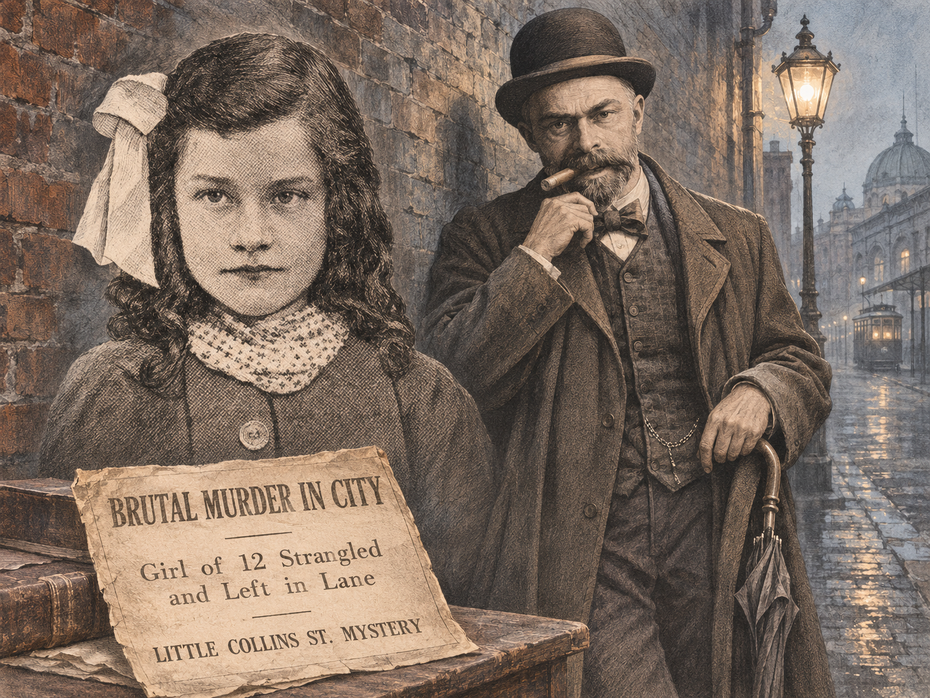
Alma Tirtschke and frederick Piggott (by chatGPT)
When news of the rape and murder of young Alma hit the newspapers on New Year’s Eve 1922 in Melbourne, Australia, readers were utterly shocked. And the frisson caused by this story was so great that reports on the progress of the investigation and, later, on the defendant’s trial dominated newspaper headlines for months on end.
On the morning of December 31, 1921, the naked body of a twelve-year-old girl was found; she had gone missing the day before after her grandmother sent her to pick up a package of meat at the butcher shop and deliver it to her aunt’s house. When she was last seen alive, she was walking through the arcade where a wine bar was located.
Alma Tirtschke was a shy, well-behaved, and studious girl who had been living with her paternal grandmother ever since she lost her mother. The photo of her chosen to illustrate the newspaper page left no one unmoved by the news: a sweet-featured little face wore a subtle smile, and her long, red hair was tied back with a huge white ribbon bow. Upon seeing that child’s face, anyone would wonder how anyone could commit such a savage act.
The case was immediately assigned to detectives Frederick John Piggott and John Brophy. Piggott was already famous by then, thanks to his tenacity and his use of forensic methods that were still novel at the time. Until then, the information the police had to solve a crime often came from informants.
Fred Piggott used photographs to document crime scenes and analyze bloodstain patterns. He also relied on fingerprints and hair comparisons. The public was fascinated by his work methods and his elegance. He was known in the press as the dandy detective and was even compared to Sherlock Holmes.
He used to say that it is the small details that matter in solving a crime. But in Alma’s case, he does not seem to have paid due attention to the strong evidence that contradicted the theory he had proposed at the start of the investigation.
When Colin Ross, who managed the Australian Wine Saloon—a bar located in a seedy part of town—was called to testify, he was just one of several people interviewed by the police. At the time, he reported seeing a girl matching Alma’s description walking through the arcade where the bar was located.
Later, a former employee of the saloon said she had heard him confess to the crime. A man who had been imprisoned with Ross also claimed to have heard a confession from him. Both received a portion of the reward offered for information. Weeks after the murder, the police seized two blankets that were in Ross’s possession. Light-colored strands of hair were found on them and sent for forensic analysis.
The government’s forensic expert noted differences between the strands found on the blankets and those taken from Alma Tirtschke’s head. Even so, he concluded that they likely belonged to the same person. The comparison of the strands of hair became one of the main pieces of evidence against Ross.
Colin Ross had an alibi for the night of the crime and swore he was innocent. Furthermore, the defense questioned the credibility of the witnesses, pointing to the former employee’s resentment toward her employer and the financial incentive of the reward. There was also no opportunity to have the strands subjected to an independent forensic analysis. Ross was ultimately convicted and hanged in 1922.
In 1998, DNA analysis of the strands found on Colin Ross’s blankets proved that they did not belong to the victim. In 2008, 86 years after his hanging, Ross received a posthumous pardon.
This case shows how the work of a famous police officer esteemed by the community, the pressure from a public thirsting for justice, and the newspapers’ pursuit of sensational headlines can ultimately contribute to a grave injustice.
Melbourne wanted justice for Alma. The newspapers demanded answers, the police identified a suspect, and the jury was convinced that the strands of hair helped prove his guilt. Eighty-six years later, when justice was finally served, Colin Ross received a pardon that he could no longer hear. And the question that gripped the city on that New Year’s Eve remains unanswered: Who killed Alma Tirtschke?
Voltar