


When the Family’s Reputation Matters More Than Your Happiness
Have you ever noticed how often people hide their families’ sordid stories from the critical gaze of others?
This happens even when the mistakes were made by relatives we don’t even care about. In those cases, it’s hard to say we’re keeping the secret out of love, isn’t it?
So, how much of this silence is really about protecting ourselves?
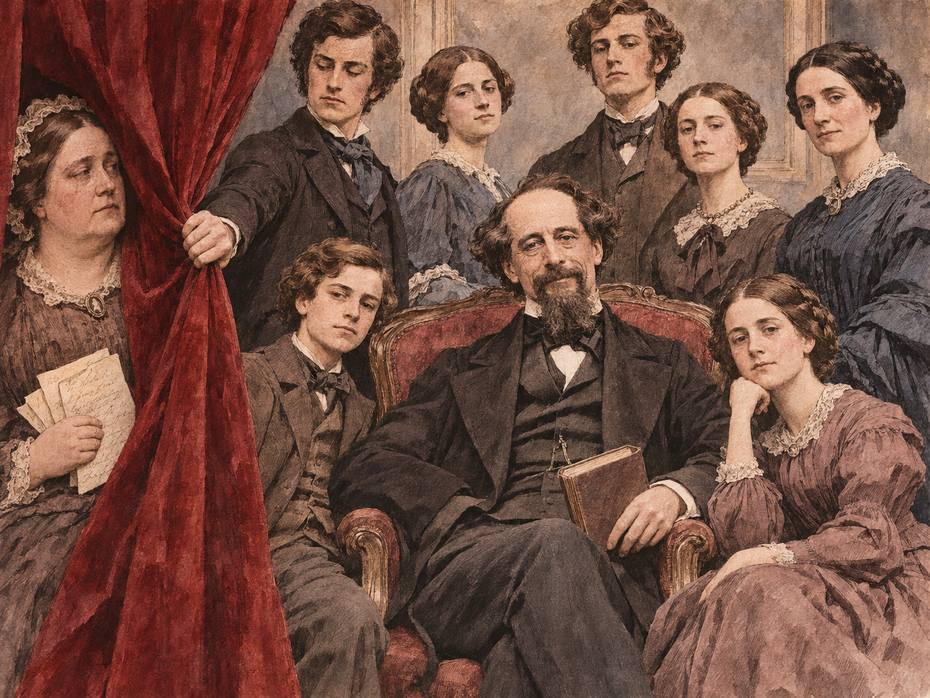
Dickens’s family poses for posterity, concerned about their image (by chatGPT)
In dysfunctional families, reporting violence—whether physical or emotional—can be treated as a more serious offense than committing it. Keeping the family’s image intact is considered a sign of loyalty to the clan. Those who speak out risk facing isolation and malicious gossip from the very people who should be offering protection.
There are also cases where acknowledging a relative’s cruelty means admitting one’s own status as a victim, facing one’s helplessness, and mourning the childhood one never had. We aren’t always able to face all of that. Maintaining the image of a happy family can make one’s own story bearable.
If, despite everything, you decide to speak out, you’ll likely hear: “Why did you put up with that?”, “Why did you keep living with them?”, “I could never have endured that in silence!” Empathy isn’t within everyone’s reach, and the victim often ends up having to explain themselves.
I was grappling with these issues when I came across accounts of the cruel treatment Charles Dickens inflicted on his wife during their separation and the reactions of their family members.
Dickens was already a famous writer when, after more than twenty years of marriage to Catherine Hogarth and ten children, he met Ellen Ternan, a beautiful actress 27 years his junior.
A divorce could have caused a scandal that would have been particularly damaging to a writer whose public image was so closely associated with domestic affection.
Dickens had a lot to lose.
Witty, lively, and an excellent storyteller, he was a charming host. His literary talent and extensive social circle had secured him a position of prestige.
But the man capable of charming so many acquaintances was also capable of publicly discrediting his own wife.
During their separation in 1858, he circulated a letter in which he claimed that Catherine neither loved her children nor was loved by them, and insinuated that she suffered from mental disturbances. According to an account recorded by his friend Edward Dutton Cook, Catherine also said that her husband had tried to have her committed to a psychiatric institution.
This was the woman with whom he had fathered ten children in fifteen years and who had accompanied him on trips and to social engagements, helping to uphold the public standing he now sought to preserve at her expense.
Catherine had to leave the house and move in with Charley, her eldest son. The others remained with their father and with Georgina, Catherine’s sister, who decided to stay by her brother-in-law’s side.
Shortly before her death, Catherine asked that the letters she had received from her husband during their courtship be sent to the British Museum, so that the world would know he had once loved her!
Georgina and Mamie, one of the couple’s daughters, helped preserve the image of a Dickens who was affectionate, fun-loving, and devoted to his family. But this memory conflicts with accounts of his capacity for acts of extreme cruelty, with his children’s fear of defying his authoritarian nature, and with the fact that he did not hesitate to plunge his family into profound unhappiness as a result of his marital crisis.
The happy moments may have been genuine. So, too, were the fear and suffering. The problem begins when fond memories are used to cover up violence.
Dickens himself knew, from childhood, the need to hide a family history. When he was twelve, his father was arrested for debt, and he began living in boarding houses and working in a shoe polish factory. He kept this painful experience a secret, revealing it to very few people.
But the silence of the helpless boy and that of the man determined to preserve his prestige had very different consequences.
Perhaps, before we demand that a family remain loyal to preserving its image, we should ask whom this secrecy protects. Because when preserving an image requires sacrificing those who have suffered, silence ultimately prolongs the very violence it seeks to hide.
Voltar